Great Recession and mass unemployment
Mr. MercedesThe Great Recession and mass unemployment are the economic conditions behind the novel’s opening job-fair crowd and the precarious work lives that follow. They make a banner promising 1,000 jobs a reason for hundreds of people to wait through the night, expose how little security remains for workers and businesses, and become part of the explanation for why the City Center crowd is so large. The recession’s effects persist in the novel’s later account of Brady Hartsfield’s planned concert attack: economic hardship helps explain the density of the first gathering, while a different bottleneck at the Mingo Auditorium shapes the danger there.
Household Insecurity and the Job Fair
The downturn reaches the story first through Augie Odenkirk, an unemployed former shipping-department office worker who remembers that two years earlier he could usually cover his expenses and have something left at month’s end. Now he cannot make sense of what has happened to the money or why his prospects have collapsed. His practical knowledge is of invoices and routing shipments by ship, train, and air; the broad economic forces that have undone his livelihood remain difficult for him to grasp. The contrast between his former ability to get by and his present unemployment gives the recession an immediate household scale.
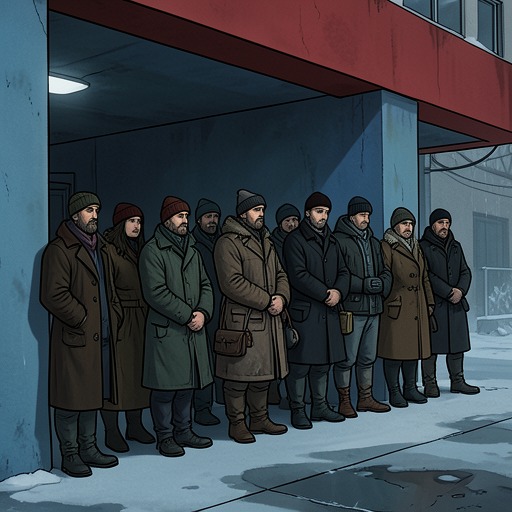
Because fuel costs money he does not have to spare, Augie leaves his still-running, high-mileage 1997 Datsun at home and takes the last bus across town. He arrives at City Center shortly after eleven at night, carrying a pack and a rolled-up sleeping bag, hoping to be first in line for the job fair. Instead, at least two dozen people are already waiting. Yellow DO NOT CROSS tape channels them through a tight, meandering queue before the doors of the auditorium, turning the effort to find work into a long wait in a space designed to hold many people close together.
Among those waiting is Janice Cray, with her baby, Patti, in a carrier. Janice explains that a job would allow her to pay for a sitter, but for this night she has no choice but to bring the child. She says an overnight sitter would have cost $84, an expense she cannot meet without endangering next month’s rent; after setting that rent money aside, she is out of funds. Her worry that other applicants will judge her for arriving with a baby makes the economic bind visible in public as well as private: the search for employment requires her to expose the very hardship that might, she fears, count against her.
As the night continues, Augie helps Janice with the practical demands of caring for Patti in the queue, and Patti is fed in the parking lot. The promise above the closed doors reads 1,000 JOBS GUARENTEED!, but that assurance does not quiet Augie’s skepticism or his anxiety about whether he will accept work as a fry cook at McDonald’s. Twenty minutes later, more cars have arrived and more people have joined the line. Augie estimates that four hundred people are already there and projects that there could be two thousand by the nine o’clock opening. The gap between a fixed number of promised jobs and an expanding crowd makes scarcity tangible before the fair has even begun.
The Recession as a Crowd-Forming Force
The job seekers’ need is not abstract. They arrive from across town, spend the night outdoors, and accept the crowding imposed by the taped route because employment is worth the discomfort and uncertainty. The queue’s design compresses people into a confined holding area, and the people closest to the doors have little room to move. When a car is driven into the densely packed crowd, those at the rear can escape more readily than the applicants trapped near the entrance; the posts and tape impede movement, and people fall and are trampled. The economic desperation that gathered the crowd therefore meets a physical arrangement that leaves the earliest and most tightly grouped applicants especially exposed.
The connection between recession and catastrophe is stated later by Pete Huntley, who suggests that many of the warehouse workers who might once have been on shift were instead among those waiting at City Center. His observation frames the attack’s setting as an irony of the downturn: the same lack of work that fills the job fair also leaves former warehouse employees available to join its crowd. The recession does not account for the driver’s violence, but it helps explain why so many people are gathered in one place at that hour, seeking a limited number of jobs.
A Wider Commercial Contraction
The economic strain also appears in Brady Hartsfield’s workplace at Discount Electronix. Anthony Frobisher describes the retailer as tottering alongside other businesses affected by the computer revolution, including newspapers, book publishers, record stores, and the United States Postal Service. The list places the store’s troubles within a broader transition in commerce and communication, rather than treating its difficulties as an isolated setback.
Discount Electronix’s planned fifty-percent-off sale precedes a management order that the company leave the DVD business by January 2011. Netflix and Redbox have undercut what was once a profitable merchandise line; what remains for the store is home computers made in China and the Philippines and flat-screen televisions that few people can afford during the deep recession. The scene binds technological change to diminished purchasing power: a business sheds a product line in response to new competitors, then depends on expensive goods that its customers cannot readily buy.
That contraction shapes Brady’s working conditions without making him a victim of the job fair or a representative voice for the unemployed. He is assigned DVD cataloguing and stickering as the store prepares to exit the category. His employer is vulnerable, his tasks are mundane, and the larger retail environment offers no picture of expanding opportunity. Elsewhere, the job fair’s banner promises abundance, while the employment market and the businesses around Brady suggest how uncertain that promise is.
Economic Conditions and Later Public Danger
The recession’s consequences recur in the novel’s treatment of public gatherings, though the evidence does not make hardship the direct cause of Brady’s violence. At the Mingo Auditorium, Brady studies the route concertgoers will use and notes that a sign prohibits bags, boxes, and backpacks. He expects more than four thousand people to enter and reasons that metal detectors would create a severe traffic jam, while security staff will be present. The planned scale of attendance and the management of entry become part of the setting for his intended attack, just as the taped queue at City Center shaped the job seekers’ vulnerability.
On the night of the concert, the lobby is not filling all at once as Brady expected. Wheelchair users are being admitted first through a designated access route toward the checkpoint and auditorium. This separate entry sequence unsettles his assumptions about the crowd and its movement. The scene makes access arrangements, rather than economic desperation, the immediate factor that disrupts his plan; the contrast with City Center is consequential. There, a mass of applicants is packed together while waiting for scarce work. At Mingo, the order of entry is structured differently, and Brady has failed to anticipate it.
As the Mingo crisis unfolds, Hodges’s attempt to contact security is briefly obstructed when his Nokia dies before he can retrieve the number. Holly provides a phone and helps him reach the police department. The episode is not presented as a direct consequence of the recession, but it belongs to the novel’s recurring attention to how vulnerable plans become in crowded emergencies: access, communication, and the practical limits of available systems can affect what people are able to do.
Significance
The Great Recession and mass unemployment connect the novel’s private anxieties to its public violence. Augie’s lost income, Janice’s inability to pay for childcare, and the hundreds of people waiting for work give the City Center gathering its social and material causes. Frobisher’s account of Discount Electronix adds another register of decline: employment and commerce are both being reshaped by forces that individual workers cannot control. Together, these details make the job fair’s guarantee of 1,000 jobs seem less like secure opportunity than a promise made against overwhelming need.
The recession is not a moral explanation for the massacre, nor does it excuse Brady’s choices. Its narrative function is more precise: it assembles a vulnerable crowd, raises the stakes of Janice’s and Augie’s immediate decisions, and supplies the circumstances behind Pete Huntley’s observation about displaced warehouse workers. The later Mingo scenes echo the opening through their crowded public spaces and controlled entrances, but also contrast with it. At City Center, economic desperation concentrates job seekers at a constrained doorway; at the auditorium, an organized access procedure becomes an unanticipated obstacle to Brady. In both settings, the movement of people through limited space carries consequences, while the recession remains a force that has already narrowed many of their choices.